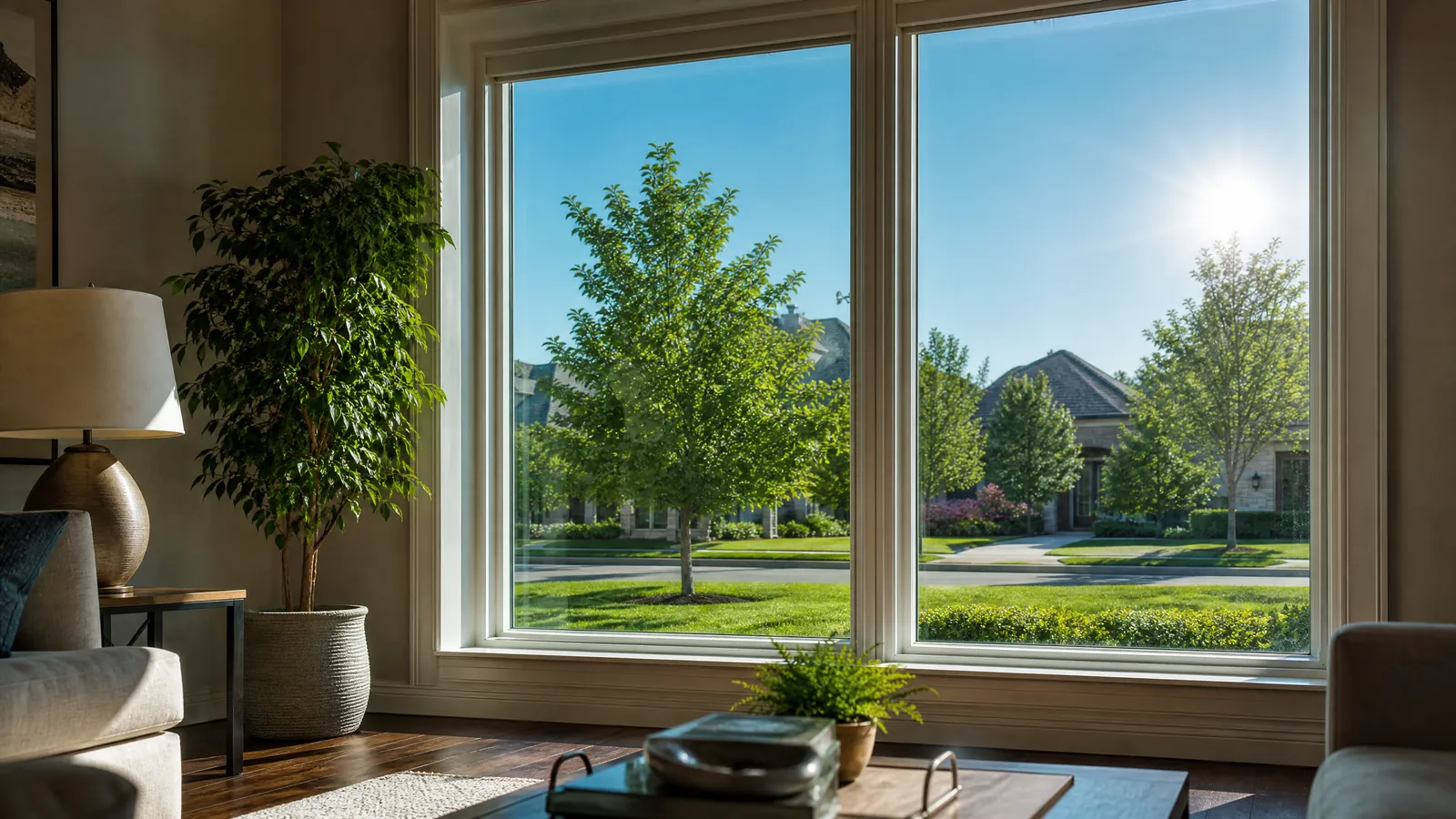
If you are replacing foggy glass in your Texas home, you have an opportunity to upgrade to Low-E (low-emissivity) glass — and for DFW homeowners, it is one of the smartest investments you can make. Low-E glass technology has advanced significantly in recent years, and the benefits are particularly pronounced in our hot Texas climate.
What Is Low-E Glass?
Low-E glass has a microscopically thin metallic coating — typically silver or tin oxide — applied to one surface of the glass. This coating is invisible to the naked eye but has remarkable properties:
- Reflects infrared heat back toward its source (keeping heat outside in summer, inside in winter)
- Blocks up to 99% of UV radiation that causes fading
- Allows visible light to pass through so your home stays bright
Think of it as sunscreen for your windows — it lets the good light in while blocking the harmful and wasteful energy.
Why Low-E Matters More in Texas
Extreme Heat Management
Dallas-Fort Worth regularly sees temperatures above 100°F from June through September. Standard clear glass allows solar heat to pour into your home, forcing your HVAC system to work overtime. Low-E glass reflects a significant portion of this solar heat, reducing cooling loads substantially.
Intense UV Exposure
Texas receives some of the highest UV radiation levels in the continental United States. Without Low-E protection, UV rays penetrate your windows and cause:
- Hardwood floor fading and discoloration
- Furniture upholstery bleaching
- Artwork and photograph deterioration
- Carpet color loss
The cost of replacing faded flooring or furniture often exceeds the cost of Low-E glass upgrades many times over.
Temperature Cycling Stress
Our dramatic temperature swings — from freezing winter mornings to 70°F afternoons — create enormous stress on window systems. Low-E glass helps moderate the temperature differential across the glass, which can actually extend the life of your window seals.
Types of Low-E Coatings
Passive Low-E (Hard Coat)
- Applied during glass manufacturing
- More durable and scratch-resistant
- Moderate solar heat rejection
- Good for colder climates or north-facing windows
Solar Control Low-E (Soft Coat)
- Applied in a vacuum chamber after manufacturing
- Superior solar heat rejection
- Better UV blocking
- Ideal for Texas and hot climates
- Must be used within an insulated glass unit (between the panes)
For DFW homes, we recommend solar control Low-E for south and west-facing windows, and passive Low-E for north and east-facing windows. This tailored approach maximizes efficiency without over-tinting your views.
Real Energy Savings Numbers
The U.S. Department of Energy estimates that windows account for 25-30% of residential heating and cooling energy use. Upgrading to Low-E glass can reduce this window-related energy loss by 30-50%.
For a typical 2,500 sq ft DFW home with 15-20 windows:
- Summer cooling savings: Pricing depends on the selected scope, dimensions, product, access, and installation conditions; see pricing and request a written quote. per month during peak season (June-September)
- Winter heating savings: Pricing depends on the selected scope, dimensions, product, access, and installation conditions; see pricing and request a written quote. per month during cold months
- **Project-specific value depends on the selected scope and conditions.
- **Project-specific value depends on the selected scope and conditions
These numbers improve further as energy costs continue to rise.
Low-E Glass and Home Value
Energy-efficient upgrades are increasingly important to home buyers. According to the National Association of Realtors, energy-efficient windows are among the top features buyers look for. Homes with Low-E glass can command higher sale prices and sell faster than comparable homes with standard glass.
The Perfect Time to Upgrade
If you already need foggy glass replacement, upgrading to Low-E glass during the same service visit is the most cost-effective approach. Since we are already removing and replacing the insulated glass unit, the additional cost for Low-E coating is minimal compared to the long-term benefits.
This is a one-time upgrade that pays dividends for the entire life of the window — typically 15-25 years.
Combining Low-E with Argon Gas Fill
For maximum efficiency, we recommend pairing Low-E glass with argon gas fill between the panes. Argon is:
- Denser than air, providing better insulation
- Non-toxic and odorless
- Stable and long-lasting
The combination of Low-E coating and argon fill creates a window system that significantly outperforms standard clear glass with air fill.
Common Misconceptions
"Low-E glass makes rooms dark"
Modern Low-E coatings allow 70-80% of visible light to pass through — your rooms will still be bright and airy. The coating primarily blocks infrared and UV wavelengths that you cannot see anyway.
"Low-E glass has a visible tint"
While older Low-E coatings had a noticeable green or blue tint, modern coatings are virtually invisible. Most visitors will not be able to tell the difference between Low-E and standard glass by looking at it.
"Low-E is only worth it for new construction"
Low-E upgrades during glass-only replacement are one of the most cost-effective energy improvements you can make to an existing home, precisely because you are not paying for new frames, trim work, or structural modifications.
Get a Low-E Upgrade Quote
Ready to upgrade your foggy windows to energy-efficient Low-E glass? Contact Apex Windows & Glass at (214) 263-3008 for a free assessment. We will evaluate your windows, recommend the right Low-E coating for each window's orientation, and provide a transparent quote. We serve 55 DFW cities across the Dallas-Fort Worth metroplex.
Additional Benefits of Low-E Glass
Beyond energy savings and UV protection, Low-E glass also offers enhanced sound dampening, creating a quieter and more peaceful home environment. This can be particularly beneficial for homes located near busy streets or in noisy neighborhoods.
Low-E Glass Across the Dallas-Fort Worth Metroplex
Low-E glass is highly recommended for homeowners across the DFW metroplex, including cities like McKinney, Frisco, and Plano. Given the extreme temperatures experienced throughout Texas, the energy efficiency provided by Low-E coatings is not just a luxury — it is a necessity. It helps create a more comfortable living space, reduces your carbon footprint, and adds value to your property.
From Collin County to Tarrant County, we serve the entire DFW metroplex. See all areas we cover and book your free window assessment.
See our <a href="/city/garland">local service page for Garland</a> for neighborhood-specific details.
Need Foggy Glass Replacement in Your Area?
We provide expert foggy glass replacement and window repair across the Dallas-Fort Worth metroplex. Click your city below for local pricing, neighborhoods served, and FAQs:
About the Author
Alvin Paulson
Co-Owner & Lead Technician, Apex Windows & Glass
Alvin Paulson co-founded Apex Windows & Glass. The company brings 30+ years of combined leadership experience to foggy glass replacement, insulated glass unit (IGU) repair, and energy-efficient window upgrades across Dallas-Fort Worth. Alvin's philosophy is simple: replace only what's broken, save the homeowner money, and explain the written product and workmanship coverage for the selected scope.