
Searching foggy window repair near me is a sensible first step when haze or moisture seems trapped between window panes. The search result, however, is only a starting list. Before authorizing a measurement or paying a deposit, compare providers on the details that affect a custom insulated glass unit (IGU): whether they truly serve your address, how they measure, what they intend to supply, and what the written terms actually say.
This is a provider-selection guide, not a diagnosis, price, repair-versus-replacement, DIY, energy-upgrade, or installation-day guide. Its purpose is to help you choose a local company with a clear process for a fogged-glass project.
Start by confirming that “near me” means your home
A provider can appear in a local search without routinely serving every neighborhood in a metro area. Ask a direct question before scheduling: “Do you serve my street or ZIP code, and will that be stated on the written estimate?” The answer should be specific rather than a broad assurance about serving an entire region.
Then verify the business details yourself. Compare the company name, phone number, website, and listed address across its website, map listing, and estimate. A consistent identity does not prove workmanship, but it gives you a reliable business to contact if you need clarification after the work is quoted or completed. It is also reasonable to ask who will be your point of contact if the estimator, office, and installer are different people.
Ask what happens at the measurement visit
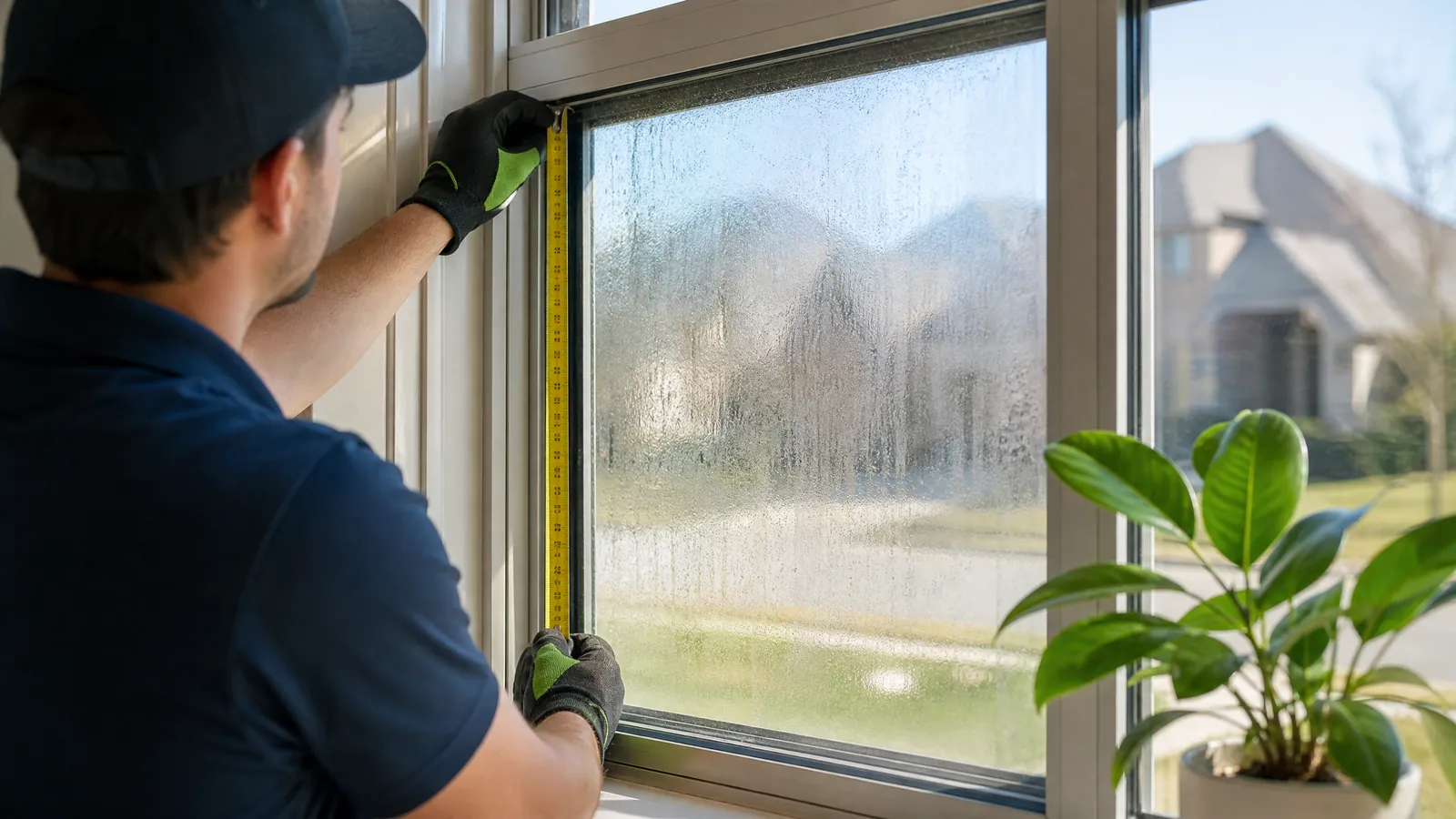
Fogged-glass work is usually custom work. The replacement needs to fit the existing opening and match the features that matter to the homeowner. A provider should inspect the affected window rather than quote from a photo alone when an on-site assessment is appropriate.
Ask the estimator to explain what will be measured and recorded. For an IGU replacement, that discussion may include visible glass dimensions, overall unit dimensions, glass thickness, spacer appearance, grid pattern, safety-glass markings, and any coating or tint you want matched. The technician should also note conditions that could affect the scope, such as damaged stops, a deteriorated frame, difficult access, or an opening that is not square.
For a closer look at the service Apex offers when the glass is the issue, visit foggy glass repair. A site visit and written scope are still the right way to confirm what a particular opening needs.
Compare the glass specification, not just the label “double-pane”
“Double-pane” is a broad description, not a full specification. Two insulated units can have different glass types, coatings, spacers, grids, safety treatment, or gas-fill options. Ask the provider to identify the intended replacement configuration in plain language and state what is being matched versus what is being changed.
If comfort, sunlight, or daylight is part of your decision, ask what performance information is available for the selected product. ENERGY STAR explains that NFRC ratings are independently tested and that U-factor describes insulating performance while solar heat gain coefficient (SHGC) describes the fraction of solar energy transmitted. Lower SHGC means less solar heat transmitted. FGIA describes insulating-glass certification as another useful point of reference. Those ratings apply to the rated product configuration, so do not assume a number from a brochure applies to every existing frame and replacement assembly.
Require a written scope before approving the job
A written estimate should let you compare providers line by line. It does not need to be complicated, but it should name the affected opening or openings and distinguish the glass work from any additional frame, sash, trim, or cleanup work.
Use this checklist while reviewing the proposal:
- Does it identify each window or opening to be addressed?
- Does it describe the planned IGU or glass configuration, including grids, tint, coating, or safety glass when relevant?
- Does it state what is included in removal, installation, disposal, and cleanup?
- Does it explain how a discovered condition outside the stated scope will be handled before extra work proceeds?
- Does it show the price, payment terms, and the provider’s contact details?
- Does it include the warranty terms or point you to them?
If an item is important to you, ask for it in the scope. Verbal assurances are easy to misunderstand once materials are ordered. A provider should be able to clarify ambiguous language rather than ask you to accept a vague proposal.
Review warranty language carefully
A warranty is useful only when you know what product and work it covers, for how long, and what conditions or exclusions apply. Ask for the actual written terms before authorizing the work. In particular, separate a manufacturer product warranty from a workmanship warranty and ask whether the terms apply to the exact item in your proposal. Do not assume terms transfer to another owner or cover every future condition unless the written document specifically says so.
For separately purchased IGUs, Apex offers a 10-year manufacturer product warranty on separately purchased IGUs and a 1-year Apex workmanship warranty; read the warranty terms for the applicable details and exclusions. Other products or services can have different manufacturer terms. If a comparison quote uses broad language such as “lifetime,” ask the provider to supply the document and point to the provision that applies to your job.
Make the final local-provider comparison
Once you have two or more written estimates, compare the clarity of the scope before comparing only the total. A lower number may reflect a different glass package, fewer identified openings, excluded work, or missing terms. Conversely, a longer estimate is not automatically better; it should be specific and understandable.
Choose the provider that can answer the practical questions clearly: Does it serve your address? What was measured? Which IGU is being supplied? What is included? What happens if site conditions change? What warranty language applies? A clear answer to each question helps you make an informed choice without relying on search ads or slogans.
If you are in Dallas–Fort Worth and want to confirm whether Apex serves your area, use the local service finder before requesting an estimate.
Compare the next step, not only the headline
A useful local provider conversation should result in a documented next step: an assessment, a measurement visit, a written scope, or an explanation of why glass-only work may not fit the condition. Compare that clarity along with the product details and warranty documentation. A low headline price without a defined glass configuration, safety requirements, or access assumptions is not necessarily comparable to a detailed proposal.
After you narrow the local list
Once you have identified providers that appear to cover your address, give each one the same information: photos of the affected windows, any evidence of between-pane haze, approximate opening locations, access conditions, and visible features such as grids or tint. This makes it easier to compare the response to the same problem rather than comparing unrelated estimates.
Ask each provider how it will confirm the condition, what it will document before ordering glass, and who will answer if the observed condition calls for a different scope. A local route to start that conversation is the Dallas service page. For the repair method itself, see the foggy glass repair service. When you are ready to discuss the windows, call Apex Windows & Glass at (214) 263-3008; the assessment should clarify the scope before a product or outcome is assumed. A clear address, access notes, and photos taken in normal daylight make that first conversation more useful without replacing an on-site review.
Frequently Asked Questions
How can I tell whether a foggy-window company really serves my area?
Ask the company to confirm your address or ZIP code and include the service location on the written estimate. Compare its name, phone number, address, and website across its business listing and proposal. A clear contact path and a specific service-area answer are more useful than a generic “near me” search result.
What should a measurement visit for fogged glass include?
The provider should inspect the affected window and explain the dimensions and features it needs to record. Depending on the opening, that can include the IGU size, glass thickness, grids, spacer appearance, coatings, safety-glass requirements, access, and visible frame condition. Ask the provider to note any condition that may change the written scope.
What should be in a written foggy-window repair estimate?
The estimate should identify the opening or openings, describe the intended glass or IGU configuration, state included work and exclusions, show price and payment terms, and explain how changes will be approved. Request clarification in writing if a material, feature, or condition is important to your decision.
Does a foggy-window warranty cover every future problem?
Not necessarily. Coverage depends on the written warranty, the product purchased, and the stated conditions and exclusions. Review the product warranty and workmanship warranty separately, keep the estimate and invoice, and ask the provider to explain which terms apply to your particular project.
Need Foggy Glass Replacement in Your Area?
We provide expert foggy glass replacement and window repair across the Dallas-Fort Worth metroplex. Click your city below for local pricing, neighborhoods served, and FAQs: