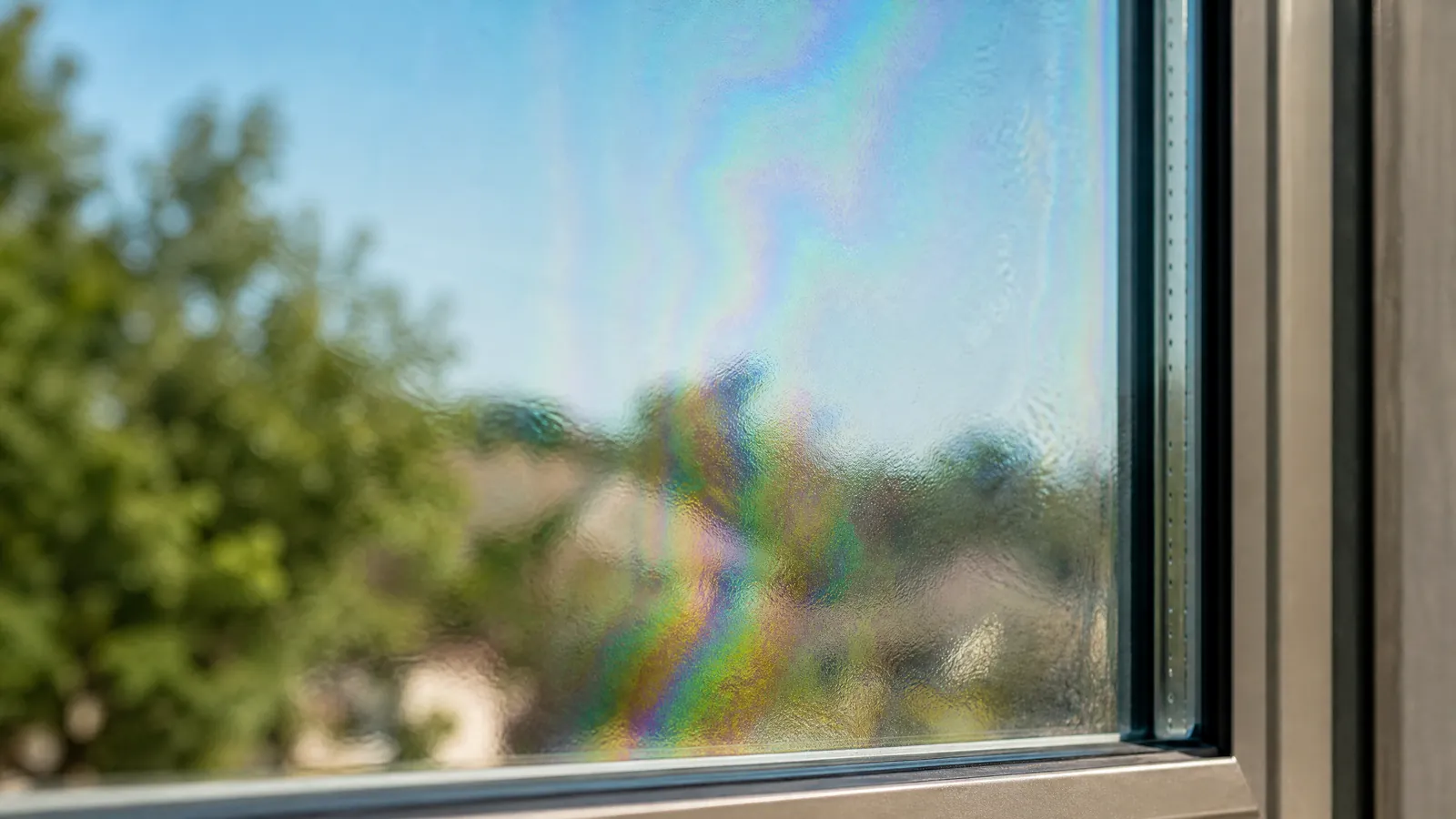
You just spent thousands of dollars upgrading your Dallas–Fort Worth home with brand-new, energy-efficient windows. But when you look closely at the glass under certain lighting, you notice something unexpected: a rainbow-colored haze, wavy lines, or a double reflection. Naturally, your first thought is that the windows are defective or the installation was botched.
Before you panic and demand a warranty replacement, it is important to understand the science behind modern insulated glass. In most cases, these optical phenomena—such as Brewster's Fringes or roller wave distortion—are completely normal byproducts of how high-performance, tempered, and Low-E glass are manufactured. However, there are specific instances where visible distortion does indicate a manufacturing defect. This guide will help you understand why your new windows look wavy or colorful, how to test the glass yourself, and when it is time to call your installer for a replacement.
Why Do My New Windows Look Wavy or Colorful?
Modern insulated glass units (IGUs) are highly engineered products designed to maximize energy efficiency and safety. Unlike older, single-pane clear glass, today's windows consist of multiple panes, specialized coatings, and heat-treated glass. These advanced features interact with light in complex ways, sometimes producing visual effects that homeowners mistake for defects.
The most common optical phenomena in new windows are Brewster's Fringes (a rainbow effect), roller wave distortion (wavy glass), and double reflections (ghosting). These effects are typically harmless and do not affect the window's structural integrity, thermal performance, or lifespan. They are simply a reflection of the physical properties of the glass and the physics of light.
Understanding Brewster's Fringes (The Rainbow Effect)
If you see a faint, rainbow-colored pattern or iridescent haze on your new windows, you are likely observing a phenomenon known as Brewster's Fringes. This effect occurs in high-quality double-pane windows when the two panes of glass are perfectly parallel and flat.
When light passes through the first pane of glass, it reflects back and forth between the inner surfaces of the two panes. If the glass surfaces are extremely flat and parallel, the reflected light waves can interfere with each other. This interference separates the white light into its component colors, creating a subtle rainbow pattern.
Brewster's Fringes are actually a sign that your insulated glass unit was manufactured with high precision. The effect is usually most visible under specific lighting conditions, such as on an overcast day or when viewing the glass at an angle. It is not a sign of a broken seal, a failed Low-E coating, or a manufacturing defect.
Roller Wave Distortion in Tempered Glass
Building codes often require tempered safety glass in specific locations, such as near doors, floors, or in bathrooms. If your new windows have tempered glass, you might notice a slight waviness or ripple effect when looking at reflections in the glass. This is known as roller wave distortion.
During the tempering process, the glass is heated to over 1,100 degrees Fahrenheit and then rapidly cooled. While the glass is hot and slightly pliable, it moves over ceramic rollers in the tempering furnace. These rollers can leave microscopic waves or indentations on the surface of the glass.
While roller wave distortion can be annoying, it is an unavoidable part of the tempering process and is considered acceptable within industry standards. It does not compromise the strength or safety of the glass. If you are unsure whether your windows require tempered glass, you should verify the building codes with your local DFW authority.
Double Reflections and Low-E Coatings
Another common visual effect in modern windows is double reflection or "ghosting." This occurs when you see a primary reflection and a slightly offset secondary reflection in the glass.
Double reflections are inherent to double-pane insulated glass units. Because there are two panes of glass, light reflects off both the inner and outer surfaces. Additionally, energy-efficient Low-E (low-emissivity) coatings, which are essential for reducing heat transfer in the hot Texas climate, are highly reflective. These coatings can amplify the double reflection effect, making it more noticeable, especially at night when it is dark outside and bright inside.
Like Brewster's Fringes and roller wave distortion, double reflections are a normal characteristic of high-performance insulated glass and do not indicate a defect.
Defect vs. Normal Physics: How to Test Your Glass
While most optical phenomena are normal, severe distortion can sometimes indicate a manufacturing defect, such as "dished" or "bowed" glass. This happens when the pressure inside the insulated glass unit differs significantly from the atmospheric pressure outside, causing the glass panes to bow inward or outward.
To test your glass for excessive bowing, you can perform a simple string test. Tape a piece of string tightly across the window frame, horizontally and vertically, so it forms an 'X' across the glass. If the glass is severely bowed, you will see a significant gap between the string and the center of the glass (concave bowing), or the glass will push the string outward (convex bowing).
| Visual Effect | Common Cause | Is It a Defect? |
|---|---|---|
| Rainbow Haze | Brewster's Fringes (Light interference) | No, normal physics |
| Wavy Reflections | Roller wave distortion (Tempering process) | No, standard manufacturing byproduct |
| Double Reflections | Double panes and Low-E coatings | No, normal characteristic |
| Severe Bowing | Pressure differences inside the IGU | Yes, potential manufacturing defect |
When to Call Your Installer for Warranty Replacement
If you have performed the string test and found significant bowing, or if the distortion is so severe that it heavily obscures your view, you should contact your window installer. Excessive bowing can put stress on the window seals, potentially leading to premature failure.
Additionally, if you notice actual moisture, fog, or condensation forming between the panes of your new windows, this is a clear sign of a broken window seal and requires immediate attention. At Apex Windows TX, we specialize in glass-only replacement for failed seals. If the frame is still serviceable, we replace just the insulated glass unit, offering up to 70% savings compared with full window replacement. We also provide a 10-Year IGU manufacturer warranty + Apex 1-Year workmanship warranty on our glass replacements. For specific warranty details on your new windows, always check with the manufacturer.
FAQ
Are rainbow reflections a sign of a broken seal?
No. Rainbow reflections, known as Brewster's Fringes, are caused by light interference between perfectly parallel panes of glass. A broken seal is indicated by moisture, fog, or condensation forming between the glass panes. To learn more about identifying seal failure, read our guide on how to tell if your window seal is broken.
Will the wavy look in my tempered glass go away?
No, the wavy appearance (roller wave distortion) is a permanent physical characteristic of the glass created during the tempering process. It will not fade or change over time.
Do triple-pane windows have worse reflections?
Yes, triple-pane windows can exhibit more pronounced double (or triple) reflections because there are more glass surfaces and often more Low-E coatings for light to reflect off of.
How far away should I stand to inspect my new glass?
Industry standards typically recommend inspecting window glass from a distance of about 10 feet, looking straight through the glass at a 90-degree angle, under normal daylight conditions (not direct sunlight). Minor distortions visible only from sharp angles or up close are generally considered acceptable.
If you have concerns about the glass in your DFW home or need an expert assessment of a potential seal failure, contact the best window company in Dallas, TX. Call Apex Windows TX at (214) 263-3008 today.
Need Foggy Glass Replacement in Your Area?
We provide expert foggy glass replacement and window repair across the Dallas-Fort Worth metroplex. Click your city below for local pricing, neighborhoods served, and FAQs:
About the Author
Alvin Paulson
Co-Owner & Lead Technician, Apex Windows & Glass
Alvin Paulson co-founded Apex Windows & Glass and brings over 30 years of hands-on expertise in foggy glass replacement, insulated glass unit (IGU) repair, and energy-efficient window upgrades. Born and raised in North Texas, Alvin has personally assessed and repaired thousands of windows across the Dallas-Fort Worth metroplex — from historic McKinney homes to new-build subdivisions in Frisco and Prosper. He is a licensed glazier and holds certifications in Low-E glass installation and argon gas window systems. Alvin's philosophy is simple: replace only what's broken, save the homeowner money, and back every job with a 10-Year IGU manufacturer warranty + Apex 1-Year workmanship warranty.