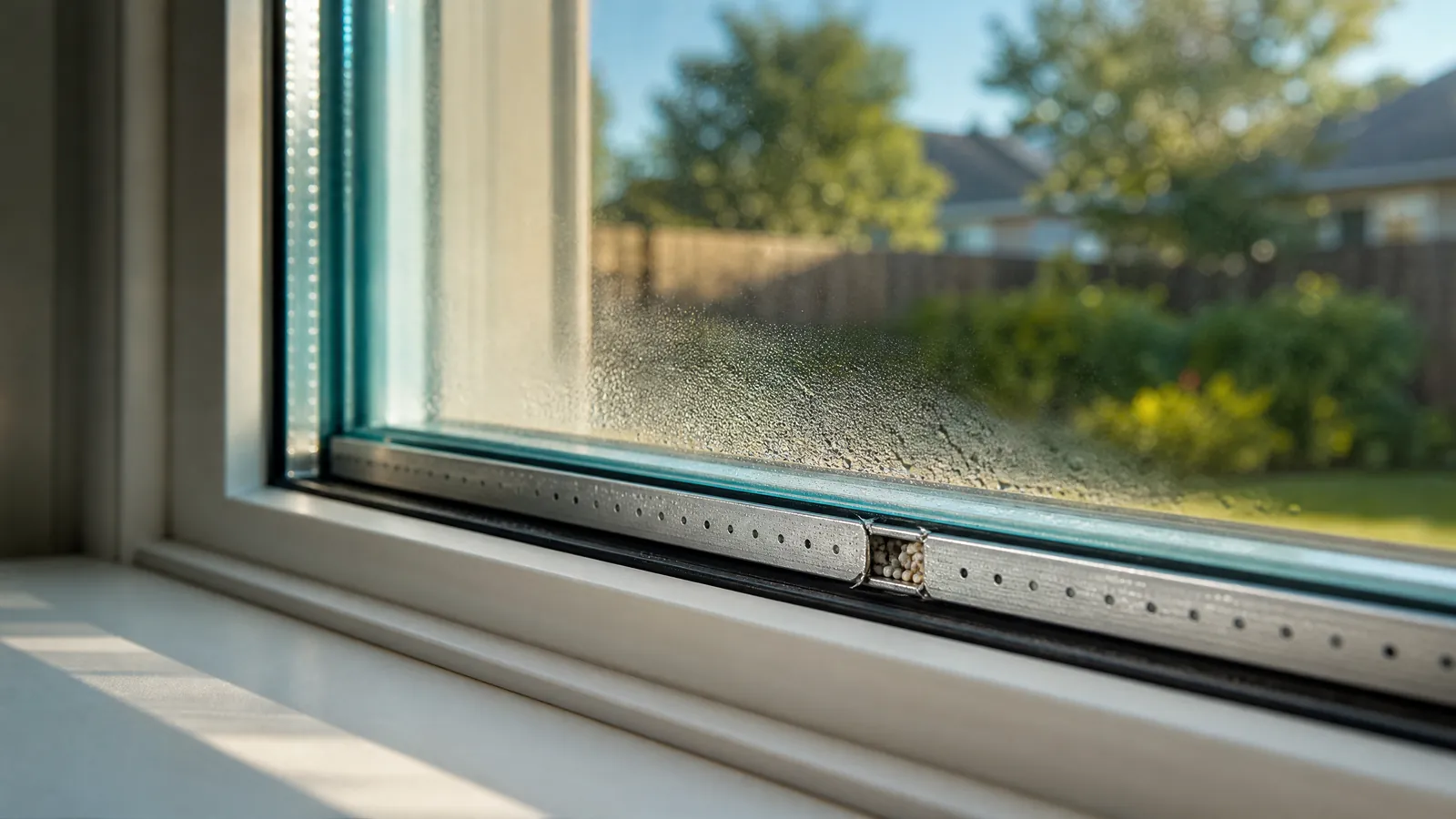
Have you wondered why condensation forms between the glass of your double-pane windows, leaving a milky obstruction you cannot wipe away? Many Dallas–Fort Worth homeowners assume their windows are just aging poorly, but the true culprit is often a hidden mechanism inside the window spacer: desiccant saturation.
Every insulated glass unit features a spacer bar that holds a moisture-absorbing material called a desiccant. This acts as an internal sponge, quietly trapping moisture that enters the air space between your panes. However, this sponge has a finite capacity. Once the desiccant reaches its limit—a process known as saturation—the excess moisture condenses on the glass, resulting in the foggy appearance that obscures your view and signals a failing seal.
Understanding this hidden clock inside your glass is the first step toward finding a lasting, cost-effective solution for your foggy windows.
The Hidden Clock Inside Your Windows: Desiccant Beads Explained
When you look at a modern double-pane window, you see two sheets of glass separated by a spacer. What you do not see are the thousands of tiny desiccant beads packed inside that spacer bar. These beads are engineered from highly porous materials, such as silica gel or zeolite, which efficiently adsorb water molecules.
The primary role of these desiccant beads is to maintain a completely dry environment between the panes of glass. Even in the highest quality windows, the perimeter seals are not perfectly impermeable over decades. Microscopic amounts of moisture vapor inevitably penetrate the seal over time. The desiccant beads capture this vapor, preventing it from condensing on the interior glass surfaces when temperatures fluctuate.
Think of the desiccant as a protective reservoir. As long as it has remaining capacity, your windows remain crystal clear. However, this capacity acts like a hidden clock, slowly ticking away as it absorbs more moisture year after year.
How Desiccant Beads Keep Your Windows Clear
The effectiveness of a double-pane window relies on the insulating gas trapped between the panes. For this insulation to work properly, the space must remain devoid of moisture. When the window is manufactured, the desiccant is completely dry and ready to perform its job.
As the window is exposed to the elements, the outer seal experiences stress. Expansion and contraction caused by heating and cooling cycles create microscopic pathways for moisture vapor to enter. As vapor breaches the seal, the desiccant immediately draws the moisture out and locks it away.
This continuous process keeps your windows clear. The desiccant acts as a silent guardian, masking the slow degradation of the window seal. Homeowners are unaware that moisture is entering because the desiccant is doing its job perfectly.
The Tipping Point: When Desiccant Reaches Saturation
The fundamental issue with desiccant beads is that they have a strict physical limit. They can only hold a specific volume of moisture before they become completely saturated. Once the desiccant reaches this tipping point, it can no longer absorb any additional water vapor that enters through the compromised seal.
When saturation occurs, the moisture has nowhere else to go. As the temperature drops—such as during a cool DFW evening or when your air conditioning is running on a hot day—the trapped moisture condenses on the coldest surface, which is typically the inner face of the glass panes. This is the moment you finally see the fog, haze, or droplets forming inside your window.
The appearance of fog is not the beginning of the problem; it is the final symptom. By the time condensation is visible, the seal has likely been compromised for months or years, and the desiccant has simply exhausted its capacity.
Why DFW Weather Accelerates Seal and Spacer Failure
The climate in the Dallas–Fort Worth area is particularly harsh on insulated glass units. The phenomenon known as "thermal pumping" is a primary driver of premature seal and spacer failure in our region.
During a typical Texas summer day, the sun heats the gas between the panes, causing it to expand. This expansion puts outward pressure on the glass and perimeter seals. As the sun sets, the gas cools and contracts, creating a vacuum effect. This daily cycle acts like a bellows, constantly stressing the window seals.
Over time, this relentless thermal pumping weakens the seals, creating tiny fractures that allow moisture-laden air to be drawn into the window during the cooling phase. The high humidity levels often experienced in DFW mean that each "breath" the window takes introduces a significant amount of moisture, forcing the desiccant to work harder and reach saturation much faster than it would in a milder climate. To learn more about this process, you can read our detailed guide on what causes window seals to fail.
Signs Your Window's Desiccant Is Saturated
Identifying a saturated desiccant is relatively straightforward once you know what to look for. The most obvious sign is the presence of condensation, fog, or a milky haze between the panes of glass that cannot be wiped away from the inside or outside of the home.
However, there are other indicators that the desiccant has failed and the seal is compromised:
Visible mineral deposits: As moisture repeatedly condenses and evaporates inside the window, it can leave behind a white, powdery residue or streak marks on the glass. Distorted glass: In severe cases of double-pane window seal failure, the trapped moisture can cause the glass to warp or bow slightly, distorting reflections. Drafts or temperature changes: If the insulating gas has escaped and been replaced by moist air, you may notice that the area around the window feels unusually warm in the summer or cold in the winter. Increased energy bills: A compromised insulated glass unit loses its energy efficiency, forcing your HVAC system to work harder to maintain a comfortable temperature.
Repair vs. Replacement: What Are Your Options?
When faced with a saturated desiccant and foggy windows, homeowners often wonder if the window can simply be repaired or "dried out." Unfortunately, once the desiccant is saturated and the seal is broken, there is no permanent way to repair the existing glass unit.
Some companies offer a defogging service where they drill holes in the glass, clean the interior, and install vents. However, this does not fix the broken seal, nor does it replace the saturated desiccant or restore the insulating gas. The window will remain structurally compromised and lack energy efficiency.
The most effective and economical solution is replacing the insulated glass unit (IGU) while keeping your existing window frames intact. At Apex, we specialize in this targeted approach. By replacing only the failed glass, we can restore your window's clarity and energy efficiency, offering up to 70% savings compared with full window replacement. This method is faster, less disruptive, and provides a permanent fix for saturated desiccants.
| Feature | Defogging Service | Glass-Only Replacement (Apex) | Full Window Replacement |
|---|---|---|---|
| Restores Clarity | Temporary | Yes | Yes |
| Fixes Broken Seal | No | Yes | Yes |
| Restores Energy Efficiency | No | Yes | Yes |
| Cost Effectiveness | Low Value | High Value (Save up to 70%) | Most Expensive |
| Preserves Existing Frames | Yes | Yes | No |
For a deeper dive into your options, check out our guide on whether foggy windows can be repaired or if they need to be replaced.
Frequently Asked Questions
What is the powder inside my window spacer?
The powder or tiny beads you might see inside the spacer bar of your window is the desiccant. It is typically made of silica gel or a molecular sieve (zeolite). Its sole purpose is to absorb any moisture vapor that enters the space between the glass panes, keeping the window clear and preventing condensation.
Can you replace the desiccant in a foggy window?
No, the desiccant cannot be individually replaced. It is sealed within the spacer bar during the manufacturing of the insulated glass unit. Once the desiccant is saturated and the window becomes foggy, the entire glass unit (IGU) must be replaced to restore the window's function and clarity.
How long do window desiccants usually last?
The lifespan of a window desiccant depends entirely on the integrity of the window seal and the local climate. In mild climates with high-quality seals, desiccants can last 20 years or more. However, in areas with severe temperature fluctuations like DFW, thermal pumping can compromise seals faster, leading to desiccant saturation in 10 to 15 years.
Does a saturated desiccant mean I need new windows?
Not necessarily. A saturated desiccant means the insulated glass unit has failed, but if your window frames are still structurally sound, you do not need full window replacement. You can simply replace the glass portion, which is a much more cost-effective solution.
Restore Your View with Apex Windows TX
Dealing with foggy windows caused by desiccant saturation can be frustrating, but you do not have to endure obscured views or pay for unnecessary full window replacements. At Apex, we replace only the insulated glass unit when the frame is serviceable, providing a clear, energy-efficient upgrade that saves you up to 70% compared to replacing the entire window.
We proudly serve the DFW area and back our work with a 10-Year IGU manufacturer warranty + Apex 1-Year workmanship warranty (please verify specific warranty details with our team). If you are tired of looking through hazy glass, contact us today to schedule an assessment. Call Apex at (214) 263-3008 to restore the clarity and efficiency of your home's windows.
Need Foggy Glass Replacement in Your Area?
We provide expert foggy glass replacement and window repair across the Dallas-Fort Worth metroplex. Click your city below for local pricing, neighborhoods served, and FAQs:
About the Author
Alvin Paulson
Co-Owner & Lead Technician, Apex Windows & Glass
Alvin Paulson co-founded Apex Windows & Glass and brings over 30 years of hands-on expertise in foggy glass replacement, insulated glass unit (IGU) repair, and energy-efficient window upgrades. Born and raised in North Texas, Alvin has personally assessed and repaired thousands of windows across the Dallas-Fort Worth metroplex — from historic McKinney homes to new-build subdivisions in Frisco and Prosper. He is a licensed glazier and holds certifications in Low-E glass installation and argon gas window systems. Alvin's philosophy is simple: replace only what's broken, save the homeowner money, and back every job with a 10-Year IGU manufacturer warranty + Apex 1-Year workmanship warranty.